
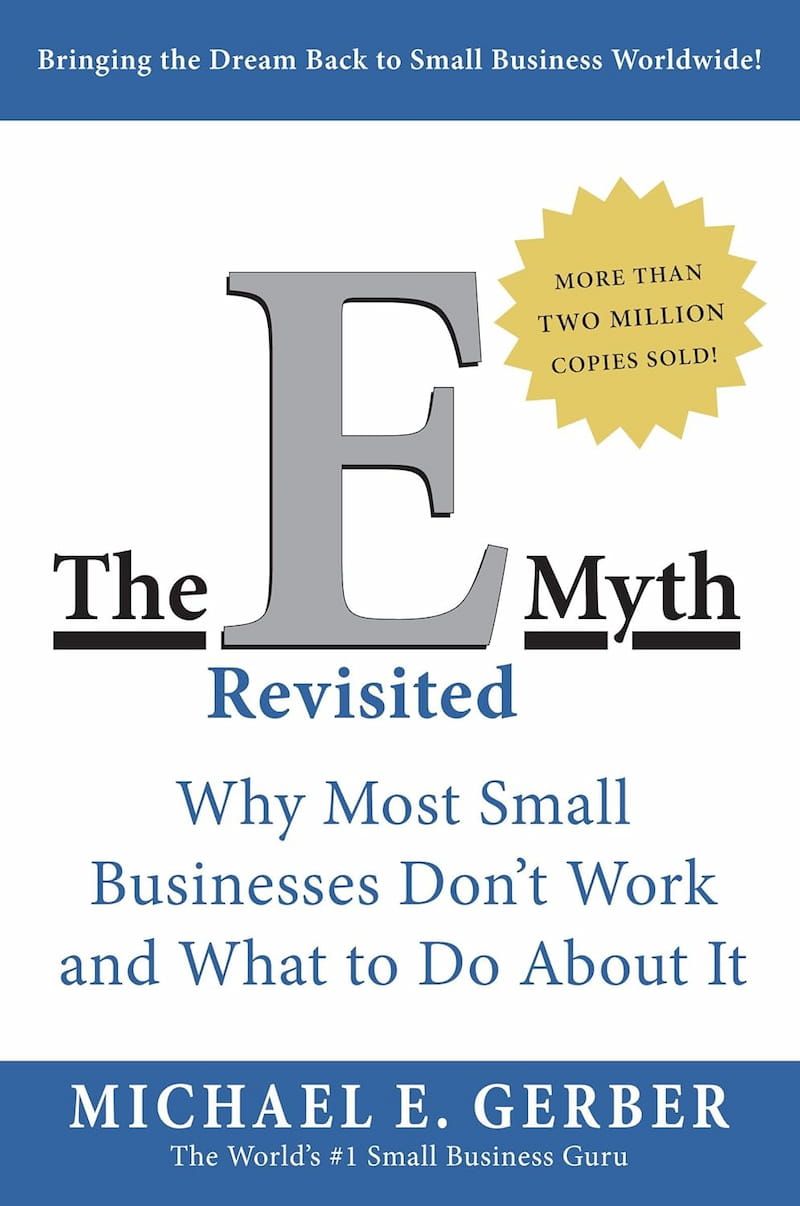
The E-Myth Revisited Summary for Founders
By Michael E. Gerber
10 Key Takeaways
Exposes the fatal trap of building a job instead of a business. Ideal early re-frame before launch.
- You’re not building a business—you’re building a job unless you escape the “do everything yourself” trap early.
- Most solopreneur ventures die because the founder is the only person who can do the actual work.
- Adopt the Franchise Prototype mindset from day one: build it like McDonald’s, so even a teenager (or AI) could run it flawlessly.
- You must juggle three personalities: Technician (does the work today), Manager (builds the systems), Entrepreneur (sees the big picture and future).
- Your real product is the business itself, not the service or widget you sell. Build it to be sellable, even if you never sell.
- Systems > Heroes: A scalable solo business runs on documented, repeatable processes—not on irreplaceable geniuses (i.e., you).
- If you do anything twice, document it. That checklist or Loom video becomes the seed of your Operations Manual.
- Block sacred “work ON the business” time every week. No client work, no admin—just strategy and system-building.
- Map the entire client journey into a predictable, step-by-step playbook (lead → sale → onboarding → delivery → offboarding → upsell).
- True freedom arrives the day the business works perfectly without you—thanks to systems, hired help, or AI doing the heavy lifting.
Steps to E-Myth a Business or how to properly set up a new business:
- Lock yourself in a room for 4–8 hours and write your Primary Aim: What do you want your life to look like in 10 years (money, hours, lifestyle, impact)? No business decisions until this is crystal clear.
- Draft your Strategic Objective: One sentence + 5–7 measurable standards (e.g., “A $3 M revenue company delivering X with 40 % net profit, 100 % referral-based, operating in 3 cities with no more than 25 hours/week from the owner”).
- Create the future Organizational Chart of the “finished” company (every box that will ever exist: CEO, Operations Manager, Marketing, Sales, Finance, etc.). Put your name in EVERY box for now.
- For each box on the org chart, write a 1-page Position Contract (results expected, standards, key performance indicators—even if you’re doing it all).
- Pick the single most important end result your customer pays for and name it your Core Deliverable (e.g., “a spotless house in 2 hours” or “a filed tax return with maximum legal refund”).
- Reverse-engineer the Customer Journey into 7–12 linear stages (Lead → First Contact → Sale → Onboarding → Delivery → Completion → Follow-up → Referral).
- Build a one-page Client Journey Flowchart showing every stage and who/what is accountable at each step.
- Start your Operations Manual (Google Doc or Notion page) with a Table of Contents matching the Client Journey stages.
- For the next 90 days, every time you do ANY task twice, immediately record a Loom video or write a checklist. Drop it into the correct section of the manual.
- Create a Master Checklist for your Core Deliverable (the exact sequence a brand-new hire or VA could follow to get the same result you do).
- Design the customer-facing deliverables as if a franchisee had to replicate them (templates, scripts, swipe files, exact branding, tone, timing).
- Write the 7 core scripts every business needs: initial phone/email reply, sales presentation, objection handling, onboarding call, upsell, offboarding/thank-you, referral request.
- Set up a weekly 4-hour Entrepreneur Time Block (same day/time every week, non-negotiable). Agenda: only strategy and system work.
- Implement a simple color-coded calendar system: Green = Technician (client work), Orange = Manager (systems), Blue = Entrepreneur (vision/strategy). Aim for 20/40/40 split within 12 months.
- Build your Lead-to-Sale System first (because cash buys you time): landing page → opt-in → automated nurture sequence → booking link → sales script.
- Create SMART Accountability Metrics for each position on your org chart (even the ones you still fill). Review them every 90 days.
- Replace yourself in the lowest-leverage box on the org chart first (usually admin or fulfillment). Hire a VA or automate before you hire for revenue-generating roles.
- Run a quarterly Franchise Prototype Test: Pretend a stranger bought your business for $1 M tomorrow. Could they run it from your documentation alone in 30 days? Fix every “no.”
- Build a one-page Company Standards Bible (dress code, response times, error policy, customer greeting, etc.)—even if it feels ridiculous when it’s just you.
- Once per year, redo steps 1–4 with your future (richer, freer) self in mind. Update the Strategic Objective and org chart. The business must keep evolving or it calcifies.
Do these 20 steps in order and you will no longer own a job—you’ll own a living, sellable, scalable system that happens to make money. Most people skip the “boring” 1–12 and stay trapped forever. Don’t be most people.
From 'Technician" to "Saleable Asset'
Michael Gerber wrote the book on the Technician Trap, the #1 reason most businesses aren't saleable. Our Saleability Audit is the first step to fixing it. We use simple AI to help you document your processes, build your Franchise Prototype, and finally start working on your business, not just in it. Read our guide on how to fix this: Your Business Isn't Saleable (Yet). Here's How to Fix It.
Get the Book & Support Kiva
Purchase the book on Amazon. Renew Prosper is an Amazon affiliate, which means we earn a modest amount (4.5%) from qualifying purchases. 100% of commissions earned from book sales are donated to Kiva.org.
Kiva is an international nonprofit that funds micro-loans for unbanked entrepreneurs around the world. From their website:
"By connecting people through crowdfunded loans, Kiva puts the power of financial inclusion in all our hands."
Supporting fellow entrepreneurs is very much aligned with Renew Prosper's mission. If you buy with the link below, you'll get the same price you would have paid anyway, so it's a win/win.